Driving in North Cyprus: 2026 Rules, Speed Limits, Fines & Foreign Driver Guide
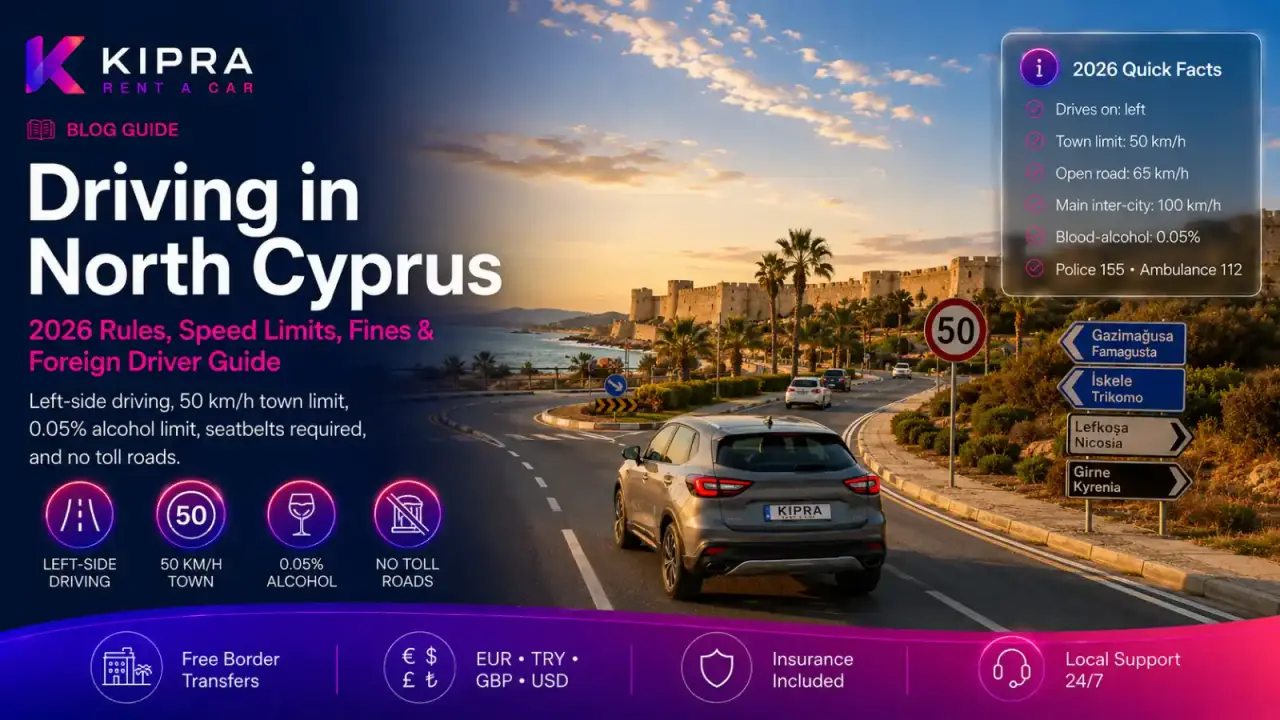
Drive on the LEFT, town limit 50 km/h, blood-alcohol 0.05%, seatbelts mandatory in every seat. Full 2026 guide — licence rules for UK / EU / US visitors, emergency numbers, what to do at an accident, the fine table in TL, and why you must never cross the south border in a North Cyprus rental car.
North Cyprus drives on the left (UK-style), the town speed limit is 50 km/h, the blood-alcohol limit is 0.05% (50 mg/100 ml), and seatbelts are mandatory in every seat, front and rear. Foreign driving licences from the UK, EU, US, Australia and Türkiye are accepted for short visits — but if you plan to cross the border to South Cyprus in your rental car, don't: the insurance void at the Green Line is the single most common way tourists get into serious trouble here.
This is the full 2026 driving guide for Northern Cyprus (the Turkish Republic of Northern Cyprus / TRNC), written by the team at Kipra Rent A Car in Famagusta. We drive these roads every day, we handle the paperwork when something goes wrong, and we've tried to leave nothing out.
2026 quick facts
Drives on: left
Town speed limit: 50 km/h
Open-road limit: 65 km/h (some signed routes 80 km/h)
Main inter-city road limit: 100 km/h (TRNC has no formal motorways)
Blood-alcohol limit: 0.05% (50 mg/100 ml)
Minimum driving age: 18 (with a valid licence)
Minimum rental age: typically 25 (some companies 21 with a young-driver surcharge)
Seatbelts: mandatory, every seat
Mobile phone: hand-held use forbidden — the single largest standard fine on the books
Toll roads: none
Currency for fuel: Turkish Lira (cash) or card; major stations accept card
Police: 155 · Ambulance: 112 · Fire: 199
What side of the road do you drive on in North Cyprus?
The left side, same as the UK, Ireland, Malta and the south side of Cyprus. Steering wheels are on the right. If you're flying in from continental Europe, the US, or anywhere else that drives on the right, give yourself the first 30 minutes on quiet roads — your instincts will fight you at junctions and roundabouts for the first day, then it clicks.
What are the speed limits in North Cyprus?
| Where | Limit |
|---|---|
| Built-up / residential (urban) | 50 km/h |
| Open roads (rural, no posted sign) | 65 km/h |
| Signed open roads | up to 80 km/h |
| Main inter-city dual carriageways | 100 km/h |
There are no motorways in the EU sense — TRNC's road network is built around two-lane and dual-carriageway inter-city roads. Speed cameras are deployed on the main Kyrenia–Famagusta and Lefkoşa–Famagusta routes and a few mountain passes. Cameras issue automatic plate-recognition fines that get forwarded to the rental company, who then bills your card.
Do I need an International Driving Permit (IDP) for North Cyprus?
It depends on where your licence is from.
UK photocard, EU photocard, Türkiye licence: accepted at face value for short visits (commonly cited as up to 90 days of tourist use). No IDP legally required, though one never hurts.
US, Canada, Australia, non-EU non-photocard licences: an IDP is strongly recommended and required by many rental companies — including most that take foreign cards as deposit. The IDP must be paired with your home-country licence; it's a translation document, not a standalone permit. Get it from your home country's automobile association before you fly — TRNC does not issue them to visitors.
In all cases, carry both documents in the car. If police pull you over and you only have your home licence with no IDP (when an IDP was required for your nationality), you're treated as driving without a recognised licence — same fine class as no licence at all.
What is the alcohol limit for driving in North Cyprus?
0.05% (50 mg of alcohol per 100 ml of blood) — same as Türkiye, slightly stricter than the UK's 0.08%. Three things to know:
Tiered fines: 0.051%–0.10% = ~21,700 TL; 0.10%–0.15% = ~43,500 TL; over 0.15% = court referral and likely licence loss.
Rental contracts often impose zero-tolerance. Even if you're under the legal limit, drinking and driving a rental car may void your insurance.
The morning after counts. One bottle of wine over dinner is enough to push some drivers over the limit at breakfast. If you're driving early, drink less the night before, or wait.
Are seatbelts and child seats required?
Seatbelts: yes, every passenger, every seat. Fine for non-compliance: ~4,350 TL per offence per person.
Child safety:
Under 5 years: must travel in a child seat, in the rear.
5–10 years: booster seat with seatbelt; may sit in front.
Above 10, regular adult seatbelt is sufficient.
Bring your own seat if you can — international airlines fly child seats for free as part of the baggage allowance. Rental-company child seats are available at most agencies but stock varies; book ahead.
Mobile phone law
Hand-held phone use while driving — calling, texting, scrolling, even at a red light — is a ~43,500 TL fine, the single highest standard fine in the TRNC traffic code. Hands-free via Bluetooth or wired earpiece is allowed. Mounting your phone in a dash holder for satnav is fine; touching it while moving is not.
How do roundabouts work in North Cyprus?
UK rules: vehicles already on the roundabout have right of way. Approaching drivers give way to the right (because traffic moves clockwise on left-hand-drive roads). Indicate left when you're about to exit; indicate right when you're going past the first exit. Plenty of local drivers don't indicate at all — assume nothing, watch what cars actually do.
Headlights and signage
Daytime running lights are not legally required, though many modern cars run them automatically.
Headlights mandatory from dusk to dawn and in poor visibility (rain, fog).
Signage is predominantly Turkish, with English added on major tourist routes. Place names appear in their Turkish form: Lefkoşa (Nicosia), Girne (Kyrenia), Mağusa (Famagusta), Güzelyurt (Morphou). Set your satnav to recognise the Turkish names or you'll miss exits.
Emergency numbers (TRNC, not the south)
| Service | Number |
|---|---|
| Police | 155 |
| Ambulance | 112 |
| Fire | 199 |
| Forest fire | 177 |
| Coast guard | 158 |
Note that 112 routes to ambulance only in the TRNC — it is not the unified European emergency number it is in the Republic of Cyprus. For police, you must dial 155.
What do I do if I have an accident?
Stop immediately. Leaving the scene is a criminal offence.
Switch on hazard lights; set the warning triangle 30+ metres back if you're on an open road.
Call 155 (police) and 112 (ambulance) if anyone is hurt. For a rental car, always call the police even if damage looks minor — your insurance claim requires the official police report.
Do not move the vehicles unless they're causing a serious traffic hazard. Photograph the scene from multiple angles before anything is moved.
Exchange details: name, address, driving licence number, insurance policy number, plate, phone. If the other driver refuses, photograph their plate and call police.
Call your rental company. Kipra customers: the emergency number is on your rental agreement; we walk you through it.
Property damage only with both drivers agreeing fault? You can complete a Maddi Hasarlı Kaza Tespit Tutanağı (property-damage report) between yourselves — but most rentals still require a police report for the insurance claim, so call 155 anyway.
Fuel, petrol stations, and payments
Fuel types: 95-octane unleaded, 98-octane unleaded, Euro Diesel. Most rental fleets — including Kipra's — run on 95.
Attendant service is the norm. Stay in the car; tell the attendant the fuel type and amount.
Payment: Turkish Lira cash or bank card. Card terminals come to your window. Contactless availability is uneven.
Hours: city stations are usually 24/7; village stations close evenings.
Price guide (early 2026): around 50 TL per litre across the three fuel types. State sets a ceiling; stations cannot exceed it. Check before you travel — TL prices move with currency.
Are there toll roads in North Cyprus?
No. TRNC has no toll motorways, no toll bridges, no electronic toll passes. The entire road network is free. Save yourself the worry — if any blog tells you to buy a transponder, it's wrong.
Parking — colour codes and city centre rules
Double yellow lines (along kerb): no parking, no waiting, any time.
Single yellow line: loading/unloading only.
Black-and-white painted kerbstones: restricted (typically no parking).
Disabled bays: marked, strictly enforced.
Public car parks in Kyrenia, Famagusta, and North Nicosia are cheap (typically a few TL per hour) and usually have space.
Standard illegal-parking fine: ~2,170 TL. Cars are not usually towed unless they're blocking traffic, but boots are deployed on persistent offenders.
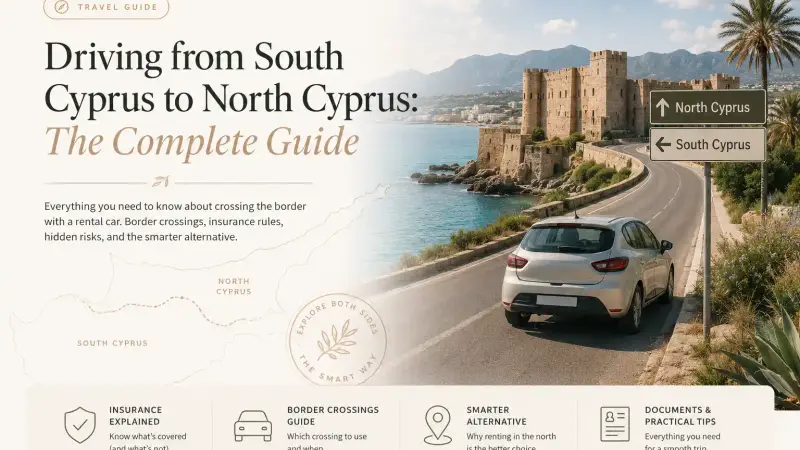
Can I take a North Cyprus rental car to South Cyprus?
No. Don't. This is the single most important rule on this page.
Kipra Rent A Car vehicles — and most North Cyprus rentals from any company — are not permitted to cross the Green Line into the Republic of Cyprus. The reason is legal and insurance-based:
TRNC-issued vehicle insurance does not cover the south side. The moment the car crosses, it is uninsured. An accident or even a parking dent down there leaves you personally liable for the full repair plus any third-party claims.
Rental contracts explicitly prohibit border crossings. Doing so voids the rental insurance entirely — meaning even damage that happens later in the north can be denied if there's a record of crossing.
If you want to visit the south side, park the car on the north side, walk through the Ledra Palace or Ledra Street pedestrian crossing in Nicosia, and either taxi or hire a separate south-side rental car for your day trip. We've helped customers organise this hundreds of times; ask us at pickup.
For the full breakdown of how the border crossing actually works, see our South-to-North Cyprus Border Crossing Guide.
Things tourists don't expect
Animals on roads. Goats, donkeys (especially on the Karpaz peninsula), stray dogs at dusk and dawn. Slow down through villages and on mountain passes. Hitting an animal at 80 km/h totals the car.
Mountain pass roads through the Beşparmak (Five Finger) range and into Karpaz are narrow, unlit, occasionally potholed. Drive them in daylight your first time.
Roundabout discipline is weaker than UK norms. Some drivers don't indicate. Some enter without giving way. Expect it, don't assume the priority rule will protect you.
Flashing headlights in TRNC means "go ahead, I'm giving way" — the opposite of the UK convention where it often means "I'm coming through." Tourists misread this and freeze at junctions.
Horn use is informational, not aggressive. A short toot from a driver behind you usually means "the light is green" or "I'm here." It's not road rage.
2026 fine table
Fines in TRNC are pegged to the gross minimum wage and re-uplift each January. The figures below are 2025-tier values — expect roughly a 15-20% uplift across the board as fines re-index to the 2026 minimum wage.
| Offence | Approx. fine (TL) |
|---|---|
| Speeding ≤20 km/h over | 4,350 |
| Speeding 20–40 km/h over | 6,520 |
| Speeding >40 km/h over | 10,870 |
| No seatbelt | 4,350 |
| Mobile phone (hand-held) | 43,500 |
| Running a red light | 8,690 |
| Careless driving | 8,690 |
| Illegal parking | 2,170 |
| Smoking / e-cig at the wheel | 2,170 |
| DUI 0.051–0.10% | 21,700 |
| DUI 0.10–0.15% | 43,500 |
| DUI > 0.15% | Court referral |
All fines are payable by credit/debit card — cash is not accepted at police stations. This catches a lot of visitors off guard.
If police pull you over
Stop calmly on the verge with hazard lights on. Lower your window. Keep your hands visible. Hand over your driving licence, IDP if you have one, the rental agreement (we give you a copy at pickup; keep it in the car), and your passport or ID. Do not offer cash — fines go through the card-only payment channel, attempts to pay in cash on the spot create more problems than they solve.
Police generally treat tourists politely. Don't argue technical points at the roadside; pay the fine via the official channel and dispute it later if you genuinely believe it was wrong.
Bottom line
The TRNC driving rules are mostly familiar to UK and EU drivers — left side, give way at roundabouts, 50 km/h in towns, seatbelts always. The three things that catch visitors out are: (1) the border-crossing prohibition with a TRNC rental car, (2) the eye-watering 43,500 TL phone fine, and (3) the wildlife on rural roads at dusk. Plan for those three, and the rest of the experience is just enjoying the drive.
Browse the fleet at kiprarent.com or book a car directly. All our cars come with full TRNC insurance, no border-crossing risk, and an emergency number to call if anything goes sideways.
Last updated: May 2026. Sources: TRNC Traffic Department, UK FCDO travel advice, local rental industry fine schedules pegged to TRNC minimum wage (2025 tier).