Salamis Ancient City: Walking the Best-Preserved Roman Ruins in the Eastern Mediterranean
Salamis was a major Mediterranean city for 1,500 years — founded around 1100 BC, finally abandoned in the 7th century AD. The ruins today cover roughly 2 km of coastline north of Famagusta: a complete Roman gymnasium with intact mosaic floors, a 15,000-seat amphitheatre, baths, basilicas. Mostly empty of tourists. This is what to see, how long it takes, and how to read what you're looking at.
Most people who visit Cyprus never see Salamis. The ones who do almost always say it was the highlight of their trip.
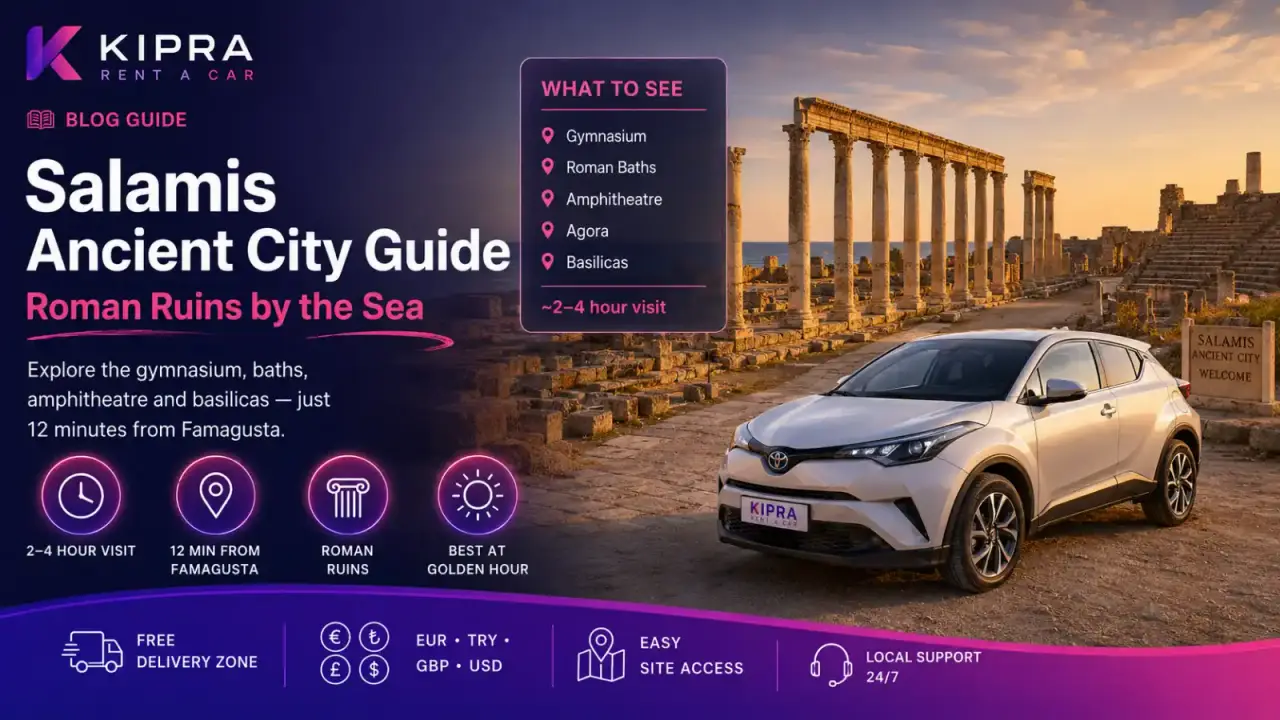
Salamis was one of the major cities of the eastern Mediterranean for fifteen centuries — founded around 1100 BC by Greek settlers, the seat of Cypriot kings under the Persians, the place Saint Paul preached on his first missionary journey in 45 AD, the Roman capital of Cyprus, and finally an early Christian metropolis until earthquakes and Arab raids forced its abandonment in the 7th century AD. The ruins today are spread along about 2 km of coastline north of Famagusta and include some of the best-preserved Roman architecture you'll see anywhere on the Mediterranean: a complete gymnasium, an amphitheatre that still seats 15,000, baths with intact heated floors, a Roman agora, two Byzantine basilicas.
You'll often have the place mostly to yourself.
Quick facts
- Founded: ~1100 BC
- Peak: Roman period, 1st-4th century AD
- Abandoned: 7th century AD (earthquakes + Arab raids)
- Distance from Famagusta: 8 km north — about 12 minutes by car
- Distance from Long Beach (İskele): 15-20 minutes south
- Entry fee: ~50 TL (approximately €1.20 — verify on arrival)
- Hours: Daily 8:00 to ~18:00 (shorter in winter)
- Time needed: 2 hours minimum to walk the site comfortably; 3-4 hours if you want to read every information board
- Best time: Early morning (cool, soft light) or late afternoon (golden light on stone, fewer visitors)
- Footwear: Closed shoes — the site is uneven stone and dust
- Bring: Water, hat, sunscreen — most of the walk is in open sun
Why locals love it
Salamis is the destination that proves North Cyprus's "uncrowded" claim is real. The major Mediterranean ancient sites — Ephesus, Pompeii, Delphi — get busy. Salamis is more impressive than most of them and you can have entire monumental buildings to yourself for ten-minute stretches. The site is well-signed (multilingual information boards), gently maintained (you can walk on the mosaic floors — carefully), and presented without the velvet ropes and crowd-control fences that make European archaeological tourism feel like queueing at an airport.
The combination of scale, preservation, accessibility, and silence is the point.
What to see (in order)
The site is laid out along a north-south spine. Start at the southern entrance (ticket office + parking), walk north, return along the coast. Suggested order:
1. The Gymnasium
The first major complex inside the entrance. A Roman athletic and educational facility, built around the 2nd century AD on the foundations of an earlier Hellenistic gymnasium. The colonnaded courtyard — surrounded by tall standing columns, many re-erected during 1950s-1960s restoration — is one of the most photographed spots in Cyprus, and rightly so.
Look for: the headless statues lining the courtyard (Roman emperors and athletes, decapitated during the early Christian period when pagan imagery was forbidden); the marble bath fragments; and the geometric mosaic floors in adjacent rooms.
2. The Baths
Connected to the gymnasium. Roman public baths followed a standard plan: frigidarium (cold), tepidarium (warm), caldarium (hot). At Salamis you can see all three — and crucially, the heated floors are still intact: a layer of stone slabs raised on small brick pillars, with hypocaust ducts channeling hot air from a furnace underneath. This was central heating, 1,800 years ago.
The bath complex also has wall paintings in fragmentary form and several intact apsidal niches that held bathing statues.
3. The Amphitheatre (Theatre)
A short walk south of the baths. Built in the 1st century BC under Augustus, the Salamis theatre is a Roman semicircular performance space that originally seated up to 15,000. The lower rows of seating are intact and you can sit on them. The stage area is mostly outlined in foundation stones.
Acoustic note: the theatre is acoustically active even today. Stand at the centre of the stage area and speak normally; someone in the upper rows can hear you.
4. The Roman Agora (forum)
The civic centre. A large open rectangle surrounded by remnants of columns, shops, and public buildings. Less visually dramatic than the gymnasium but conceptually fascinating — this is where Salamis's public life happened for 600 years.
5. Saint Barnabas Basilica + Saint Epiphanius Basilica
Two early Christian basilicas at the northern end of the site. Saint Barnabas Basilica (5th century) marks where Salamis's Christian patron was buried; the building is in foundation form but the floor plan is fully readable. The nearby Saint Epiphanius Basilica is larger and includes a baptistry.
For deeper context, the modern St. Barnabas Monastery (small museum + chapel) is 1 km east of the main site — worth 30 minutes if you have time.
Getting there
From Famagusta city centre: 12 minutes north on the coastal road. The turn-off is well-signed (brown archaeological-site signs). From Long Beach (İskele): 15-20 minutes south on the same road.
Parking: Free, unpaved lot at the southern entrance. Plenty of space.
A Kipra-specific note: the road to Salamis is the same coastal road we use for Long Beach deliveries. Browse the fleet — any economy car handles this drive easily.
Photographer's notes
- Gymnasium colonnade: late afternoon, sun low to the west, the columns cast long parallel shadows. The single most photographed angle in Salamis
- Theatre: mid-morning, sun illuminating the rows from above. The empty seating with the sea visible past it makes the better shot
- Mosaic floors: flat morning or overcast — the colors are washed out in direct hard sun
- Baths' hypocaust: flash-off, available light only, low angle from outside the apsidal niches
- Bring a wide-angle lens if you have one — the gymnasium is wider than a single 50mm frame can capture
Combine with
- Half-day: Salamis (morning) + Famagusta's Walled City (afternoon) — two layers of the same history
- Beach + history pairing: Salamis (morning, before sun gets hard) + Long Beach (afternoon swim)
- Saint Barnabas Monastery: 5 minutes drive east of the main site — small museum + chapel + tomb. Especially worth visiting if you went into the basilicas first.
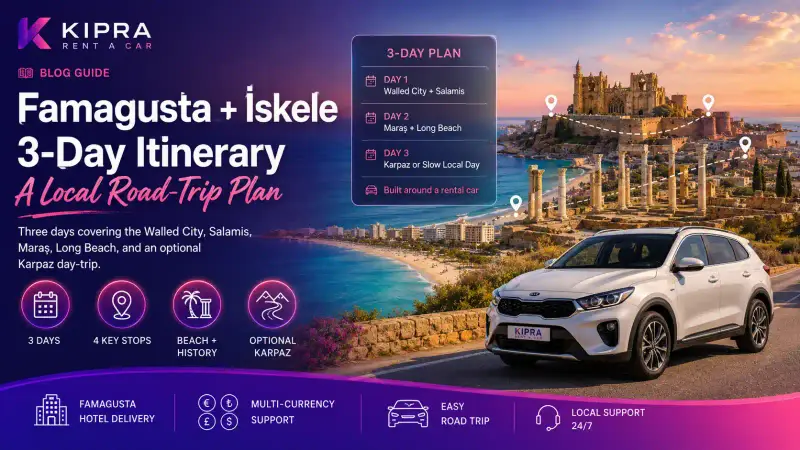
- The full 3-day itinerary puts Salamis on day 1 afternoon, after a Walled City morning
Bottom line
Salamis is the destination that surprises archaeology-curious travelers the most. The combination of scale (15,000-seat theatre, hectare-sized gymnasium), preservation quality (Roman heated floors still functional in concept), and lack of crowds is genuinely rare in the modern Mediterranean. Two hours is the minimum. Three is more honest. Bring water and shoes that grip dusty stone.
Browse the Kipra fleet or book a car directly. The drive to Salamis is part of our free delivery zone from Famagusta and Long Beach.